

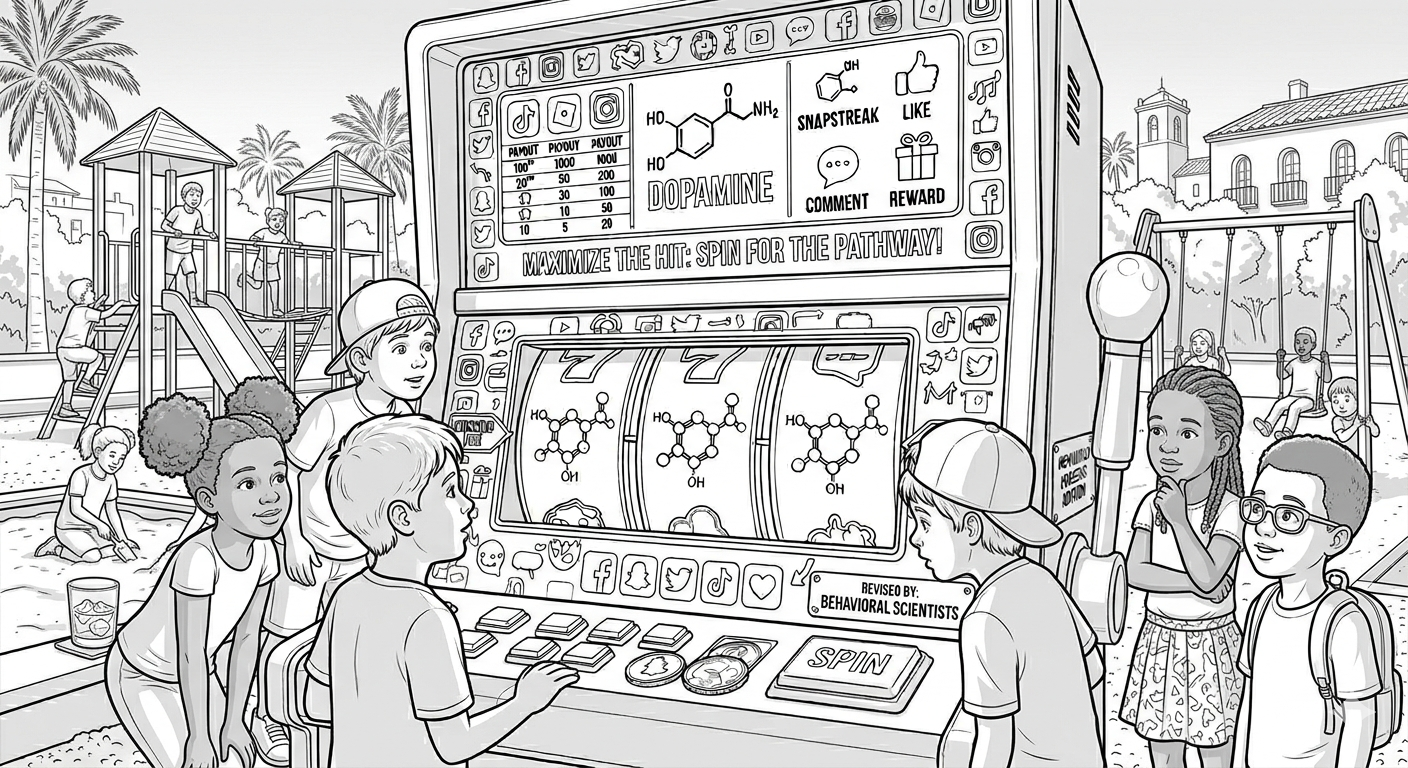
Why Your Kid Can’t Put Down Their Phone
They’re not being difficult. Their brain’s been hacked.
That blue light at the dinner table? It’s firing off the exact same neural circuits that make slot machine players think “just one more spin.”
The ancient system that pushed our ancestors to track down their next meal is now locking your second-grader into a six-hour Roblox session.
This is what happens when corporations weaponize neurochemistry.
Getting Dopamine Wrong
Everyone assumes dopamine means feeling good. Nope.
Dopamine is wanting. Your brain dumps it when a reward might be coming. Not when the reward arrives—when you think it could.
That gap between maybe and definitely? That’s where the trap lives.
Picture yourself opening TikTok. Your dopamine’s already spiking before you see anything.
- Maybe it’ll be trash.
- Maybe it’ll be gold.
- Maybe your ex finally watched your story.
The not-knowing is what gets you.
“Maybe” triggers bigger hits than “yes.” Behavioral scientists named this variable reward scheduling. Vegas calls it a business model.
They Designed It This Way
None of this happened by accident. Tech companies literally hired brain researchers and behavior specialists to figure out maximum stickiness.
Sean Parker—Facebook’s first president—said the quiet part loud: “We need to give you a little dopamine hit every once in a while.”
TikTok’s algorithm is genuinely frightening. It watches what spikes your dopamine, then just… keeps serving that.
The “For You” page isn’t about caring. It’s targeting you like a smart bomb finds heat signatures.
Every single feature marketed as “helpful” is actually a cage:
- Autoplay? Not saving you effort.
- Pull-to-refresh? Not about convenience.
These mechanics exploit your reward anticipation circuits on purpose. Kids have zero defense against this stuff.
Young Brains Don’t Stand a Chance
The prefrontal cortex—your impulse control center, your long-term planning department—doesn’t finish cooking until around age 25.
Teenagers are basically driving without working brakes while Silicon Valley builds the fastest cars imaginable.
When adults get notifications, several brain areas kick in. The prefrontal cortex asks: “Does this matter? Can I deal with it later?”
Kids lack that fully functional filter. The dopamine signal blasts through unregulated.
And here’s what nobody mentions enough: Tolerance builds.
Like any substance, your brain adjusts to constant dopamine floods. You need stronger hits for the same buzz.
Activities that used to excite a kid—climbing trees, finishing books, actual conversations—start feeling dull next to algorithmic stimulation that’s been optimized to beat reality itself.
Normal life literally cannot compete with software designed to be more compelling than the physical world.
Your Phone Is a Casino
Social media runs on identical psychological mechanics as gambling machines:
- Pull the lever (scroll down).
- Big win sometimes (perfect meme, crush texted back, your post blew up).
- Nothing sometimes.
- Something medium sometimes.
That randomness isn’t a bug. It’s the whole point.
Guaranteed good content every third scroll? Boring. Nothing ever appearing? You’d quit.
Random good stuff though? Your brain learns to keep pulling. One more swipe. One more refresh. This could be it.
Snapchat streaks are evil genius here. They built an artificial loss system—drop your streak, lose your standing—that forces daily check-ins. Not from genuine desire. From a hijacked dopamine circuit screaming about potential loss.
Gaming took it even further. Loot crates, login bonuses, season passes, timed events. Pure dopamine manipulation machinery.
Your kid doesn’t play Fortnite because it’s enjoyable. They play because missing a session means falling behind, and their brain’s been conditioned to freak out at that thought.
What It Actually Looks Like
Really observe a kid on their device. Don’t just glance.
They’re not casually browsing. They’re hunting. Eyes flicking everywhere. Fingers on autopilot.
Swipe, tap, scroll, swipe. Faster than thinking allows. They’re not choosing each action—the dopamine system’s driving automatically.
Pull the device away and watch withdrawal that mirrors drug addiction.
- Crankiness.
- Panic.
- Can’t focus on anything else.
- Physical agitation.
Kids describe it like an unreachable itch.
Because functionally, that’s what’s happening. Their brain learned the phone delivers dopamine. Now it wants that chemical dump like it wants oxygen.
This isn’t comparison or metaphor. The actual neural networks involved in basic survival needs activate when heavy users lose device access.
And we keep giving these dopamine dispensers to younger kids. Average first smartphone age hit 10.3 in 2023. Some parents hand tablets to two-year-olds.
We’re conducting an enormous unsupervised experiment on growing brains.
No One’s Fixing This
Tech companies won’t self-regulate. Why should they? Attention IS the product.
More engagement equals more revenue. They answer to shareholders, and “we made our app less addictive” tanks stock value.
Government regulation lags decades behind. By the time laws pass, companies already moved to new manipulation techniques.
Schools ban phones but kids hide them. Plus the dopamine conditioning already happened at home. Started the first unlimited access to an engineered irresistibility machine.
Parents feel swamped, often hooked themselves, fighting to set limits while surrounded by families who surrendered.
What Actually Works
Kids can’t self-regulate this. Not from weakness or stupidity. Because developing brains cannot resist industrial-scale dopamine engineering. Might as well expect a ten-year-old to resist heroin through pure willpower.
Hard boundaries work:
- Bedrooms stay tech-free.
- Phones don’t come to dinner.
- No smartphones until 9th grade.
- Device-free Saturdays.
Not punishment—protection from commercial exploitation of incomplete neural architecture.
Kill all notifications except actual calls. Delete social media from phones completely—desktop only if you’re allowing it period. Remove infinite-scroll apps. Break the automatic behavior that defaults to screens.
Find different dopamine sources. Kids need alternative chemical pathways:
- Sports deliver dopamine through physical wins.
- Music through making something.
- Building actual objects.
- Real human connection.
Physical reality has to become the main dopamine supplier again. Not what happens when batteries die.
Because right now we’re growing an entire generation whose reward circuitry is tuned to screens. Brains trained to crave digital approval over tangible experience. And each day that pattern strengthens, reversing it gets harder.
Dopamine doesn’t lie. Just doesn’t give a damn whether the source helps or destroys you.
Sources & Further Reading
Dopamine and Reward Anticipation Research
Schultz, W. (2015). Neuronal Reward and Decision Signals: From Theories to Data. Physiological Reviews, 95(3), 853-951.
https://journals.physiology.org/doi/full/10.1152/physrev.00023.2014
Adolescent Brain Development
Casey, B.J., et al. (2019). The Adolescent Brain. Developmental Review, 28(1), 62-77.
https://www.ncbi.nlm.nih.gov/pmc/articles/PMC2500212/
Giedd, J.N. (2004). Structural Magnetic Resonance Imaging of the Adolescent Brain. Annals of the New York Academy of Sciences, 1021, 77-85.
https://www.nimh.nih.gov/about/organization/dnbbs/child-psychiatry-branch
Tech Design and Persuasive Technology
Harris, T. (2016). How Technology is Hijacking Your Mind. Medium/Thrive Global.
https://www.tristanharris.com/
Social Media and Dopamine
Haynes, T. (2018). Dopamine, Smartphones & You: A battle for your time. Harvard Science in the News.
https://sitn.hms.harvard.edu/flash/2018/dopamine-smartphones-battle-time/
Screen Time and Child Development
American Academy of Pediatrics (2016). Media and Young Minds. Pediatrics, 138(5).
https://publications.aap.org/pediatrics/article/138/5/e20162591/60349/Media-and-Young-Minds
Twenge, J.M., & Campbell, W.K. (2018). Associations between screen time and lower psychological well-being among children and adolescents. Preventive Medicine Reports, 12, 271-283.
https://www.sciencedirect.com/science/article/pii/S2211335518301827
Gaming and Reward Systems
King, D.L., & Delfabbro, P.H. (2018). Predatory monetization schemes in video games and internet gaming disorder. Addiction, 113(11), 1967-1969.
https://onlinelibrary.wiley.com/doi/full/10.1111/add.14286
Smartphone Adoption Age Statistics
Common Sense Media (2023). The Common Sense Census: Media Use by Tweens and Teens.
https://www.commonsensemedia.org/research
Technology Addiction and Withdrawal
Rosen, L.D., et al. (2013). Is Facebook creating “iDisorders”? The link between clinical symptoms of psychiatric disorders and technology use. Computers in Human Behavior, 29(3), 1243-1254.
https://www.sciencedirect.com/science/article/abs/pii/S0747563212003305
Sean Parker’s Admission on Facebook Design
Allen, M. (2017). Sean Parker unloads on Facebook: “God only knows what it’s doing to our children’s brains.” Axios.
https://www.axios.com/2017/11/09/sean-parker-facebook-exploits-human-vulnerability