
I won’t forget: watching Big Tech leaders bowing at the inauguration of the new U.S. president.
Politics and business have always been intertwined, of course, but that scene felt different. Like a veil had dropped.
The message was unmistakable: we’re in charge, and we’re here to stay.
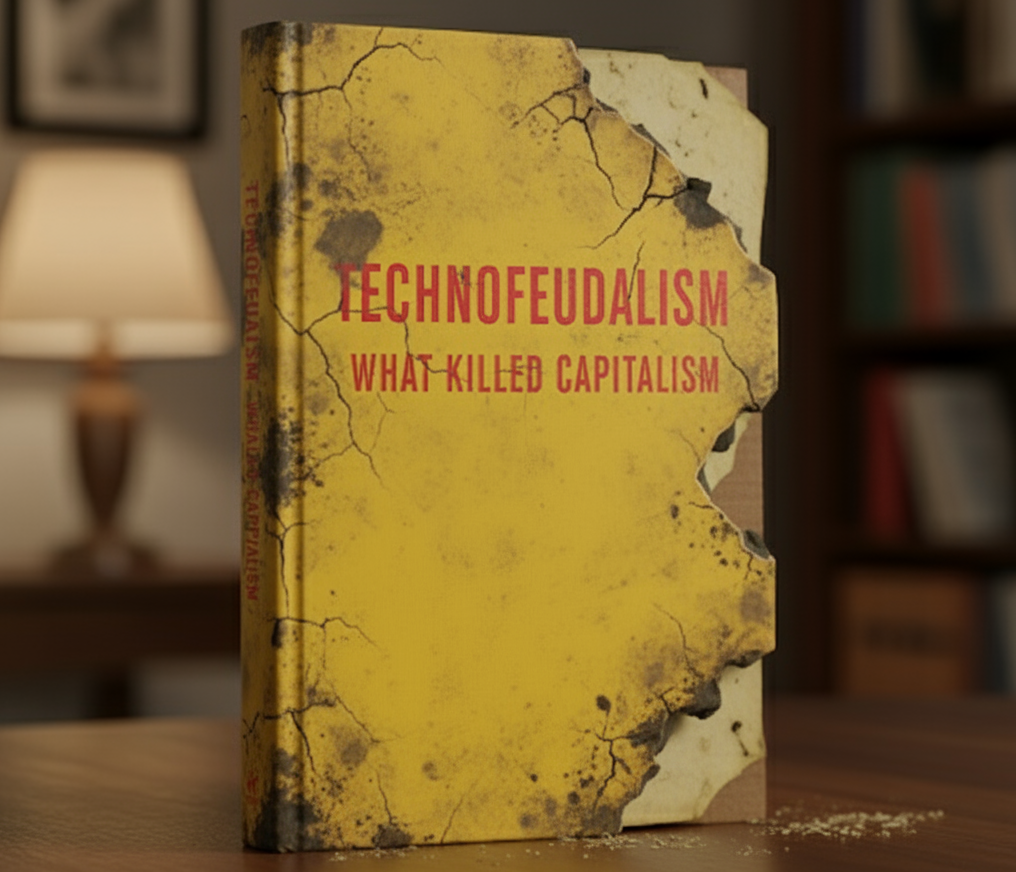
This summer I read a book that really got under my skin:
Technofeudalism: What Killed Capitalism by Yanis Varoufakis
For context: Yanis Varoufakis is an economist, academic, and politician, best known as Greece’s finance minister during the 2015 debt crisis.
A sharp critic of global finance and austerity, he has a knack for cutting through jargon and revealing the power structures underneath.
In this book, he turns his attention to Big Tech, mapping how the digital economy is quietly reshaping the world.
When I stumbled into Varoufakis’ book, it was like he had put words to the uneasy feeling I’d been carrying ever since.
His argument is daring: capitalism, as we know it, is over.
In its place is a new order, technofeudalism, dominated by digital platforms and powered by what he calls cloud capital.
As Varoufakis writes:
“Capitalism has been replaced, not by socialism, but by a new form of feudalism built on cloud servers.”
From Pentagon Project to Digital Powerhouse
What fascinated me most was his historical tracing of the internet.
It began as a decentralized military project, designed to survive conflict and disruption.
Over decades, it morphed into the backbone of Big Tech’s dominion.
And here’s the shocker: this system doesn’t need paid workers in the traditional sense.
It runs on us.
Every post, search, swipe fuels these platforms.
They don’t earn profits the old-fashioned way, they collect cloud rent.
Apple’s 30% cut from App Store sales, Amazon’s fees for sellers, Tesla’s vehicle data — all tolls we pay just to participate.
Varoufakis describes it perfectly:
“We no longer work for wages alone; our every online action is unpaid labor feeding the lords of the cloud.”
Living in Digital Castles
Varoufakis’ feudal metaphor really hit home.
In medieval times, peasants rented land from lords.
Today, we’re all tenants in digital castles.
Amazon sellers don’t own their stores.
App developers don’t control the marketplaces.
Even Tesla drivers contribute data streams that flow straight back to the company.
We live in ecosystems we don’t govern, rules set by unseen lords whose power grows while ours diminishes.
“States today do not challenge the platforms’ dominance, they simply compete to host their castles,” he observes.
Even the European Union, which has tried to implement a tax system on Big Tech products in Europe, often hesitates out of fear of repercussions.
It’s a small reminder that even powerful governments tread lightly when confronting these digital giants.
Capitalism, Subordinated
The part that really unsettled me: even traditional capitalists now play by Big Tech’s rules.
A game developer may design the next blockbuster, but if Apple or Google changes the policies, their business can vanish overnight.
It’s less about competition and more about survival under a lord’s whim.
States and Platforms: Who’s Really Calling the Shots?
Varoufakis also highlights the tension between governments and platforms.
At first glance, it looks like states still hold sway — banning TikTok, investigating Amazon, regulating apps.
But zoom out, and it’s clear: governments aren’t acting as protectors.
They’re just rival lords, jockeying for control over territory in the digital realm.
The U.S. backs its tech giants.
China safeguards Alibaba and Tencent.
The EU battles Apple and Google, though often cautiously, aware of the potential political and economic fallout.
Citizens? Workers? Rarely part of the conversation.
My Takeaway
Finally giving a name to what I have been feeling was happening is both awe and unease.
Technofeudalism isn’t some distant threat; it’s already here.
Billions of us feed it daily, often unknowingly, while the spoils accumulate in the hands of a tiny elite.
Even big antitrust moves, like the FTC going after Amazon, feel like drops in a digital ocean.
Without deeper restructuring, the feudal loop tightens, and we remain tenants of platforms we cannot control.
For me, Technofeudalism is not just an economics book.
It is a lens that makes the digital world come into focus.
Suddenly, the architecture behind the apps and platforms we use daily became visible.
If you’ve ever sensed that something is off about the power Big Tech wields, this book gives you language to understand it.
It’s unsettling, but clarifying.
Once you see these digital castles for what they are, you can’t unsee them.